
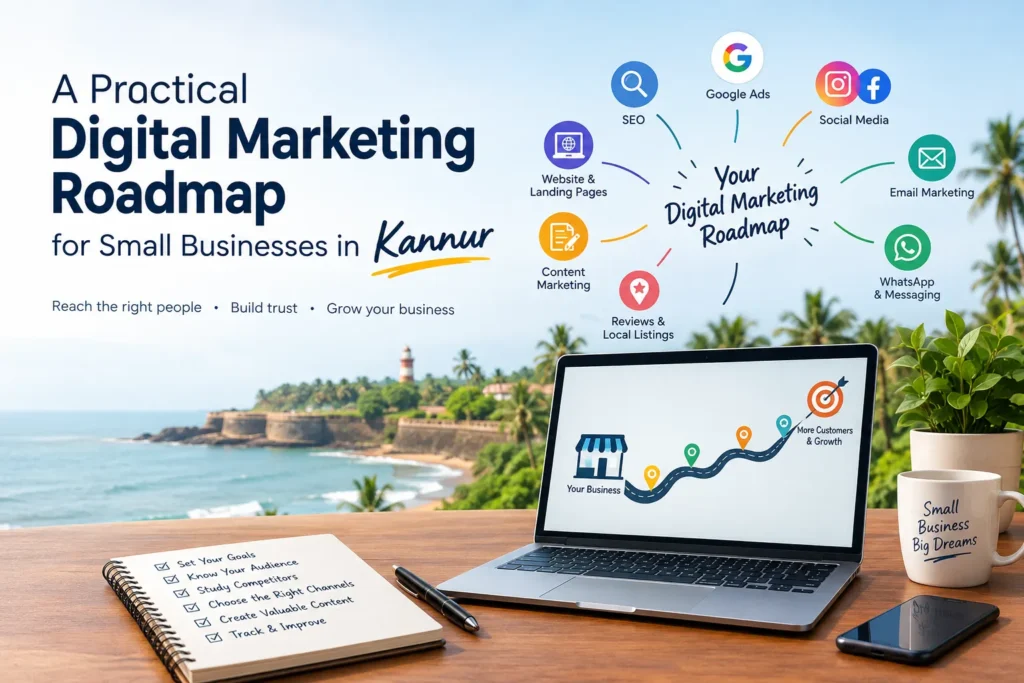
Running a small business today is no longer just about having a good product or service. Your customers are searching online, comparing options, reading reviews, checking social media pages, and looking at websites before making a decision.
This is where a digital marketing strategy becomes important.
But digital marketing doesn’t mean being active on every platform or spending a huge amount on advertisements. For a small business, the goal is to identify where your customers are, what they need, and how your business can reach them effectively.
As a freelance digital marketing strategist in Kannur, Kerala, I help businesses look at digital marketing as a structured growth strategy rather than simply posting content online.
Instead of trying to promote your business on every online platform, start by understanding where your potential customers are actually looking for you.
A small business can use digital marketing to become easier to find, build trust with potential customers, and turn online visitors into real enquiries or sales. But this works best when each activity has a clear purpose.
That is where a digital marketing strategy comes in.
What Does a Digital Marketing Strategy Actually Mean?
Think of it as a roadmap for your online marketing efforts.
It helps you decide who you want to reach, what you want to achieve, which platforms are worth your time, what kind of content you should create, and how you will measure the results.
For a small business, having this direction is important because time and marketing budgets are usually limited. Instead of posting randomly or spending money on ads without knowing what is working, you can focus your efforts on activities that have a better chance of bringing the right customers to your business.
So, how do you create a strategy that actually works for your business?
Let’s break it down.These channels can include:
- Search engines like Google
- Social media platforms
- Websites and landing pages
- SEO
- Content marketing
- Email marketing
- Google Ads and Meta Ads
- Online reviews and local listings
- WhatsApp and other communication channels
Instead of randomly posting on Instagram or running advertisements, a strategy connects these activities to a clear business objective.
For example:
Business Goal → Target Audience → Digital Channel → Content/Offer → Conversion → Measurement
That simple framework can make your marketing much more focused.
1. Start With a Clear Business Goal
Before creating social media posts or running advertisements, decide what you actually want digital marketing to achieve.
Your goal could be:
- Getting more local customers
- Increasing website traffic
- Generating enquiries
- Getting WhatsApp leads
- Increasing online bookings
- Building brand awareness
- Increasing sales
- Promoting a new product or service
For example, imagine a small salon in Kannur.
Instead of setting a vague goal like:
“I want more followers.”
A more useful goal would be:
“My goal is to increase enquiries from customers in Kannur through Google Search, social media, and my website over the next three months.”
The second goal gives you something measurable to work towards.
Make Your Goals SMART
Your goals should ideally be:
Specific + Measurable + Achievable + Relevant + Time-bound
For example:
“Aim to bring in more website enquiries over the next three months by improving your SEO, content, and calls-to-action.”
This gives your marketing strategy direction from the beginning.
2. Understand Your Target Audience
You cannot create effective marketing without understanding who you’re trying to reach.
Ask questions such as:
- Who are my ideal customers?
- What age group are they?
- Where do they live?
- What problems do they have?
- What are they searching for online?
- What influences their buying decision?
- Where do they usually spend time online?
- What information do they look for before buying?
For a local business in Kannur, location can be particularly important.
For example, a bakery may target customers searching for:
- Best bakery in Kannur
- Cakes in Kannur
- Birthday cakes near me
- Custom cakes in Kannur
- Wedding cakes in Kannur
Knowing what your customers are searching for makes it easier to create content that answers their needs.
3. Research Your Competitors
You don’t need to copy your competitors. You need to understand what they’re doing and identify opportunities for your business.
Look at:
- Their websites
- Google Business Profiles
- Instagram pages
- Facebook pages
- Content strategy
- Customer reviews
- Offers and promotions
- Search visibility
- Advertising activity
Ask yourself:
What are they doing well?
And more importantly:
What are they missing?
Perhaps competitors have good Instagram pages but poor websites.
Maybe they have websites but don’t appear for important local searches.
Or perhaps they have many customers but very few online reviews.
These areas can give your business a chance to stand out and offer something your competitors may be missing.
4. Build a Strong Online Presence
Before spending money on advertising, make sure your basic digital presence is ready.
For most small businesses, this includes:
A Professional Website
Your website should clearly communicate:
- What you offer
- Who you serve
- Why customers should choose you
- Your location
- Contact details
- Services/products
- Testimonials or reviews
- A clear call-to-action
A website doesn’t always need to be complicated.
For a local business, a simple, fast and mobile-friendly website can be more useful than an expensive website filled with unnecessary features.
Google Business Profile
If your business serves customers in a particular area, appearing in local Google searches can help more nearby people discover you.
A properly maintained Google Business Profile can help potential customers find:
- Your business location
- Phone number
- Website
- Opening hours
- Photos
- Reviews
- Products or services
Encourage genuine customers to leave reviews and keep your business information updated.
5. Make Your Business Easier to Find on Google
When people need a product or service, one of the first places they often turn to is Google. SEO (Search Engine Optimization) helps your website become more visible for searches related to what your business offers.
For a small business, this means creating useful website content, targeting relevant search terms, improving your pages, and making it clear to Google what your business is about.
The goal isn’t simply to get more website visitors. It’s to attract people who are genuinely looking for the products or services you provide.
For a small business, local SEO can be especially valuable.
Instead of trying to rank for extremely broad keywords, focus on searches related to your service and location.
For example:
Service + Location
- Digital marketing agency in Kannur
- Digital marketing consultant in Kannur
- Interior designer in Kannur
- Wedding photographer in Kannur
- Dental clinic in Kannur
You can also create useful content around questions your customers are searching for.
For example, a wedding photographer could create content around questions such as:
“What should you look for when choosing a wedding photographer in Kannur?”
A digital marketing professional could answer questions like:
“What should a small business check before hiring a digital marketing professional?”
The purpose of this content isn’t just to include keywords or chase higher rankings. It should provide useful information to people who are already looking for answers related to your business.
The objective is to appear when someone is already looking for what you offer.
6. Create Content With a Purpose
Content marketing is more than posting something every day.
Before publishing anything, be clear about what you want that piece of content to achieve.
A simple content strategy can include four types of content:
Educational Content
Teach your audience something useful.
Examples:
- How to choose the right skincare product
- 5 things to check before buying a laptop
- How to maintain your car
- Common mistakes small businesses make with SEO
Problem-Solving Content
Create content around the challenges your potential customers are facing.
For example:
“Getting views on Instagram but still not receiving enquiries? Here’s what could be going wrong.”
Trust-Building Content
Give potential customers a reason to feel confident about choosing your business. You can do this by sharing customer experiences, previous work, results, behind-the-scenes moments, or useful insights that demonstrate your expertise.
Examples:
- Customer testimonials
- Case studies
- Behind-the-scenes content
- Team introductions
- Before-and-after results
Promotional Content
Tell customers about:
- Offers
- New products
- Services
- Events
- Discounts
- Limited-time deals
A good strategy balances these instead of turning your social media page into one continuous advertisement.
7. Choose the Right Social Media Platforms
You don’t have to be everywhere.
A small business may not have the time or resources to actively manage Instagram, Facebook, LinkedIn, YouTube, Pinterest and TikTok simultaneously.
Start with the platforms where your target customers actually spend time.
For example:
Instagram → Visual products, lifestyle brands, restaurants, salons, fashion and personal brands
Facebook → Local communities, older audiences, local businesses and promotions
LinkedIn → B2B businesses, professionals and service providers
YouTube → Tutorials, educational content, demonstrations and long-form content
The right platform depends on your audience — not on which platform is currently trending.
8. Create a Simple Content Calendar
Consistency becomes easier when you plan your content in advance.
If you’re managing your content on your own, a simple weekly plan can help you stay consistent without making content creation overwhelming.

This is only a starting point, you can adjust the schedule based on your business, audience, and available time.
The important thing is to create a system that your business can realistically maintain.
Consistency is better than creating 20 posts one week and disappearing for the next month.
9. Use Paid Advertising Strategically
Organic marketing takes time. Paid advertising can help businesses reach specific audiences faster.
Platforms such as Google Ads and Meta Ads can be useful for small businesses when campaigns are properly planned.
For example:
A restaurant in Kannur could run ads targeting people within a specific geographic area.
A service business could use Google Ads to reach people actively searching for its services.
An online business could use Meta Ads to promote a product to a defined audience.
But don’t start with:
“Let’s spend ₹10,000 on ads.”
Start with:
“Who are we targeting? What are we offering? What action should they take? How much is a customer worth to the business?”
Then decide the advertising budget.
10. Make the Customer Journey Simple
Your marketing should guide people naturally from discovering your business to taking action.
For example, someone might:
See your Instagram content → Visit your profile → Explore your website → Check your services → Contact you on WhatsApp → Make an enquiry → Become a customer
Each stage should give them the information they need and make the next step obvious. If someone is interested in your service, don’t make them search around to figure out how to contact you.
Make sure your content includes clear calls-to-action such as:
- Send us a message
- Book a consultation
- Visit our website
- Get a quote
- Call us today
- Shop now
- WhatsApp us
Don’t make your audience guess what they should do next.
11. Track the Right Metrics
Followers and likes can be useful indicators, but they don’t always tell you whether your business is growing.
Track metrics that connect with your actual business goals.
Website
- Website traffic
- Organic traffic
- Landing page visits
- Conversion rate
- Enquiries
Social Media
- Reach
- Engagement
- Profile visits
- Website clicks
- Messages
- Lead
Advertising
- Click-through rate
- Cost per click
- Cost per lead
- Conversions
- Return on ad spend
Local Marketing
- Google Business Profile interactions
- Calls
- Website visits
- Direction requests
- Customer reviews
The most important question is:
“Is digital marketing contributing to business growth?”
12. Start Small and Improve
You don’t need a massive marketing budget to begin.
Start with the fundamentals:
Step 1: Define your business goal
Step 2: Understand your target audience
Step 3: Research competitors
Step 4: Build your website and local presence
Step 5: Work on SEO
Step 6: Create useful content
Step 7: Choose the right social platforms
Step 8: Test paid advertising when appropriate
Step 9: Measure results
Step 10: Improve what works
Digital marketing is not a one-time activity.
Your strategy should evolve based on customer behaviour, performance data and changing market conditions.
Common Digital Marketing Mistakes Small Businesses Should Avoid
1. Trying to Be Everywhere
Being active on five platforms doesn’t help if you can’t maintain any of them properly.
2. Posting Without a Strategy
Random content may generate views but may not generate customers.
3. Ignoring Local SEO
If your business serves a specific area, local search visibility can be extremely valuable.
4. Focusing Only on Followers
A smaller audience that actually becomes customers can be more valuable than a large audience that never purchases.
5. Running Ads Without Tracking
Spending money on advertisements without monitoring results makes it difficult to understand what is working.
6. Ignoring Reviews
Customer reviews can influence how potential customers perceive a local business.
7. Expecting Instant Results
SEO, content marketing and brand building generally require consistency and continuous improvement.
Final Thoughts
A successful digital marketing strategy doesn’t mean trying to do everything at once. Choose the platforms that make sense for your audience, create content you can maintain consistently, and invest in advertising only when it supports a clear business goal.
What matters most is having a focused approach and improving it as you learn what works for your business.
What you need is a clear understanding of:
Who you want to reach → What they need → Where they search → What you can offer → How you can convert them → How you will measure the results.
For small businesses in Kannur and across Kerala, combining local SEO, a strong online presence, useful content, social media and targeted advertising can create a more structured path towards online growth.
The goal of digital marketing isn’t simply to get noticed.
The real goal is to attract the right people and turn that interest into genuine business opportunities.
Looking for a Digital Marketing Strategist in Kannur?
If you run a small business in Kannur and want to build a stronger presence online, the first step isn’t necessarily to do more marketing. It’s to understand what your customers are looking for and choose the digital channels that can genuinely help your business reach them.
As a freelance digital marketing strategist in Kannur, I work with businesses to develop practical digital marketing strategies based on their goals, audience and market.
Have a business in Kannur and wondering where to start with digital marketing? Let’s explore what could work best for your brand, audience, and goals.
Great work! This article provides meaningful insights and useful information. I enjoyed reading it and hope to see more quality content like this.
— Muhammad Fayiz | Freelance Digital Marketer
Thank you so much for your kind words and support, Muhammad! Glad you found it helpful.